Don't Let Their Worry Become Your Decision
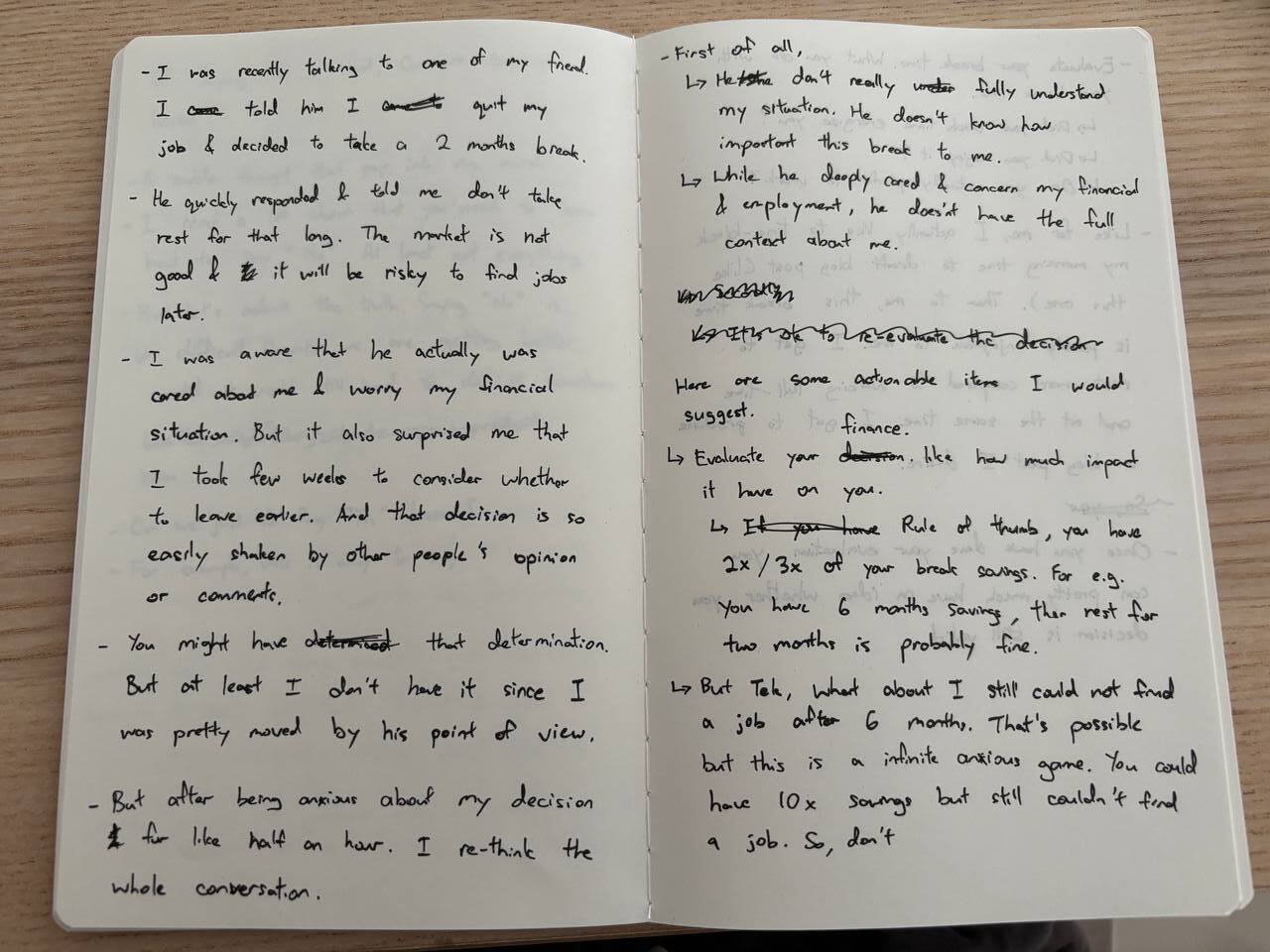
I was recently talking to a friend. I told him I’d quit my job and decided to take a two-month break.
He responded quickly. Don’t rest that long, he said. The market isn’t good. It’ll be risky to find jobs later.
I knew he cared. I knew he was worried about my finances, my employment, my future. His concern was real. But what surprised me was how easily my decision shook.
I’d spent weeks considering whether to leave. Weeks of weighing, imagining, slowly arriving at something that felt right. And then one conversation — maybe five minutes — and I was sitting there anxious, wondering if I’d made a mistake.
The Half-Hour Spiral
I was anxious for about half an hour.
Not a panic. Just a slow, grinding doubt. The kind that doesn’t announce itself loudly but sits in your chest and quietly revises everything you thought you’d settled.
You might have the kind of determination that doesn’t bend when someone disagrees with you. I don’t. His point of view moved me. I could feel myself slipping from “this is my decision” to “maybe he’s right and I’m being naive.”
Then I stopped and re-thought the whole conversation.
What I Realized
First, he didn’t fully understand my situation. He cares about me, but he doesn’t know how important this break is to me — what it represents, what I’m trying to recover, what I need to step away from to see clearly again.
He has context about the job market. He has context about financial prudence. He doesn’t have the full context about me. And that’s not his fault. But it means his advice, while well-intentioned, was shaped by a picture that was missing pieces.
It’s okay to re-evaluate a decision. That’s not weakness. But re-evaluating under the weight of someone else’s fear is different from re-evaluating with your own clarity.
A Few Practical Checks
If you’re considering a break — or you’ve already decided on one — here are the checks I ran through after that conversation:
Evaluate your break time itself. What are you doing with it? Does it energize you? Do you enjoy it? Or do you secretly prefer working?
For me, I time-block my mornings to draft blog posts. That rest is productive in a different way. I get to recover more than I would working full-time, and I still produce something I care about. That tells me the break isn’t empty. It has shape and purpose.
Look at your finances honestly. How much impact will this break actually have? A rough rule of thumb: have two to three times your break length in savings. If you want to rest for two months, and you have six months of savings, you’re probably fine. If you have three months, it’s tighter, but not impossible — it just means the margin is thinner and you need a clearer plan.
But what if I still can’t find a job after six months?
That’s possible. But here’s the trap: this is an infinite anxiety game. You could have ten months of savings and still worry. You could have two years and imagine some catastrophe that empties it. There’s no number that guarantees safety, because the part of you that’s anxious isn’t really doing math — it’s looking for certainty, and certainty doesn’t exist.
So don’t.
Don’t let their worry become your decision.
One Last Thing
The break you need is not a luxury. It’s not an indulgence you have to defend to everyone who asks. It’s a decision you made and it’s yours to hold or revise based on what you know, not what they fear.
My friend wasn’t wrong to warn me. But he wasn’t right about me, either. Only I can be that.